Sunday, 23 October 2016

Leonard Cohen - You Want It Darker (Audio)

Turtle House CEO


Thailand's Government has met with representatives from Internet giant Google, amid growing calls from Thai hardline royalists to bring those who insult the monarchy to justice, as many Thais look with uncertainty to a future without their revered king.

Thailand's Government has met with representatives from Internet giant Google, amid growing calls from Thai hardline royalists to bring those who insult the monarchy to justice, as many Thais look with uncertainty to a future without their revered king.

King Bhumibol Adulyadej's death on October 13 has thrown the country of 67 million into mourning.
It has also led to the rise of ultra-royalist vigilante groups who say they will punish anyone perceived to have insulted the monarchy during a highly sensitive time for Thailand.
Deputy Prime Minister Prajin Juntong said he met with Google representatives in Bangkok.
Google affirmed in the meeting it would continue to help the Government remove content from YouTube, a Google subsidiary, that it deemed offensive, he said.
That conforms with Google's practice around the world, Alphabet Inc's Google said.
"We have always had clear and consistent policies for removal requests from governments around the world and we continue to operate in line with those policies," a Google spokesperson said.
Thailand's royal insult law, known as Article 112 in the criminal code, makes it a crime to insult the king, queen, heir or regent.
Those who are found guilty face up to 15 years in prison.

Royal anthem honours King


Meanwhile, a massive crowd has gathered in central Bangkok to sing a special version of Thailand's royal anthem in honour of the deceased King.
A large field in front of the ornate Grand Palace complex was packed with black-clad mourners, as were all the approach roads.
Police eventually closed the roads to traffic.
The king's body is lying in one of the palaces in the complex while royal funeral ceremonies are going on.
No date has been set for cremation, which will likely take place after a year.
Reuters/AP

Philippines President Rodrigo Duterte to meet China's President in historic visit

Philippines President Rodrigo Duterte to meet China's President in historic visit

ANALYSIS
Updated Thu at 9:08am
President Rodrigo Duterte's four-day visit to China will reset the China-Philippines relationship and critically, the conflict in the South China Sea.
The Chinese are describing the visit as a "new dawn" and a turning point. The country's aim is to lure the Philippines away from the United States and weaken its strategic position in the region. 
It will be a big win for the rising superpower.
The Philippines has been one of America's staunchest allies in Asia since the end of World War II. It hosts five large US military bases and allows the US to use an air base at Palawan, which is only about 150 kilometres from the disputed Spratly islands.
China has constructed three military bases there in the last couple of years. 
The bases are critical for American forces to project power in the disputed South China Sea and they are also essential for America's pivot or rebalance back into Asia. So, needless to say Washington will be watching closely when President Duterte holds meetings with Chinese President Xi Jinping and Premier Li Keqiang.
It is of course unlikely, despite President Duterte's rhetoric, that he will "break up with America and go to China" or that any US bases will be dismantled upon his return. There is a deep historical and people-to-people connection between the US and Philippines, and recent polls show Filipinos overwhelming favour America over China.
But what will come from the visit is the restoration of relations after four years of tensions that started when the Philippines brought the case against China's claims over the South China Sea to the international tribunal at the Hague. 
Last July it ruled China had no territorial or historical rights over the South China Sea — a decision China rejected. 
But China wants Mr Duterte's visit to demonstrate to other ASEAN countries that there is a new model, a new way.

Trade, aid and tourism

Mr Duterte is going to get a raft of trade and aid packages, including new railways, energy and tourism deals. A four-year ban on tropical fruits will be lifted and that is worth billions to the Philippines. There is also talk that an arms deal will be signed.
Here too, China will progress it agenda. Many of the deals will be funded and administered by China's new global bank — the Asian Infrastructure Investment Bank.
That is about changing the rules of the global financial game towards China and pushing out the Western-centric financial institutions like the World Bank and IMF. 
China hopes President Duterte's trip will send a powerful message to the rest of the ASEAN countries: if you come to our side there are tangible benefits from our growing wealth and power. 
China wants to break the largely united front that ASEAN has against it on the South China Sea. They want to pull ASEAN out of the US orbit and into China's.
Chinese President Xi Jinping was working on this just last week with a trip to Cambodia.
Cambodia has pledged strong for China and in return got 31 economic agreements, soft loans of $300 million, military aid and infrastructure projects like high-speed rail and airports. 
China now accounts for 20 per cent of capital spending in Cambodia.
We are likely to see the same scale tomorrow when President Duterte walks the red carpet at the Great Hall of the People and shakes President Xi Jinping's hand. It will signal the start of an era and China wants to use it to deepen control in South China Sea.
There is also expected to be a sweetener. 
China is likely to give the Philippines back some of it's fishing rights in the Scarborough Shoal. China seized it from the Philippines back in 2012 and this became the basis of the case at the international tribunal in the Hague.
This gesture will undermine the Hague ruling.

N. Korea expected to test-fire at least 5 more Musudan missiles: report

N. Korea expected to test-fire at least 5 more Musudan missiles: report

2016/10/21 11:35
SEOUL, Oct. 21 (Yonhap) -- North Korea is expected to make at least five additional attempts to test-fire its intermediate-range Musudan missiles down the road, a media report said Friday.

Citing Markus Schiller, an aerospace engineer at Munich-based ST Analytics, U.S.-based media Radio Free Asia (RFA) reported the North's launch the previous day of a Musudan missile following last week's failed launch appears to be an attempt to upgrade its engine.

Schiller, quoted by RFA, said the North was fortunate enough to have made a successful launch of a ballistic missile to date in a process of test-firing many missiles that it produced at a time. "But North Korea will likely face many failed launches and make at least five to 10 additional attempts to test-fire ballistic missiles," he said.

The Musudan, which can be launched from a mobile launcher, is estimated to have a range of over 3,000 kilometers, or 1,800 miles, and is theoretically capable of reaching the U.S. territory of Guam.

The latest launch is the eighth Musudan missile fired off this year by the reclusive country. Of the eight, a missile launched on June 22 flew 400 km and reached an altitude of over 1,400 km. Others blew up immediately after being launched, which may indicate that Pyongyang has not fully mastered related missile technology.

According to Schiller, the North is likely to go through a process similar to the Soviet Union in the past in which it produced 10, 20 or 30 units simultaneously, attempted a raft of missile launches and upgraded them before deploying them.


namsh@yna.co.kr 

U.S. deploys armored brigade to South Korea

U.S. deploys armored brigade to South Korea
Rotational deployment of 3500 troops comes amid growing tensions over nuke tests, THAAD
October 21st, 2016

The U.S. Army will deploy an armored brigade division to South Korea in the coming months as part of a nine-month rotation, according to a recent press release.
The deployment of 3,500 soldiers from the 1st Armored Brigade, 1st Infantry Division will replace a brigade from the 1st Cavalry Division currently on the peninsula.
The move comes amidst heightened tensions in the region, with the DPRK pushing a seemingly fast-tracked weapons testing schedule and South Korea agreeing to deploy an advanced U.S.-made THAAD missile system.
“The U.S. armored brigade includes powerful tanks and helicopters, and its fighting power is considered to be equivalent to – or possibly more – than the ROK armored division,” Kim Min-seok, a senior researcher at the Korea Defense and Security Forum told NK News.
Taskandpurpose.com reports that many of the 1st Armored Brigade’s soldiers have already arrived in South Korea. They will mostly be deployed at Camp Casey, a short distance from the Demilitarized Zone (DMZ).
“Most of the maneuver units, i.e. tanks and infantry, are already located (at Camp Casey),” NK NewsIntelligence Director John Grisafi said.
The troops will join existing mechanized forces in South Korea and take part in military exercises alongside South Korean troops.
“The ROK and the U.S. already have a couple of mechanized divisions in Korea. The armored division will only be meaningful during the times of full-scale war, and has almost no relations to the North’s nuclear weapons, which is currently the biggest security concern,” Kim added.
The deployment follows two North Korean tests of intermediate long range missiles. U.S. Strategic Command detected two failed launches of the midrange Musudan system over the last week.
The Tuesday test was North Korea’s eighth test of the Musudan, though only one has been considered a success.
The first launch was condemned quickly by the UN Security Council, who described it as a “grave violation of the Democratic People’s Republic of Korea’s international obligations under UNSC resolutions.”
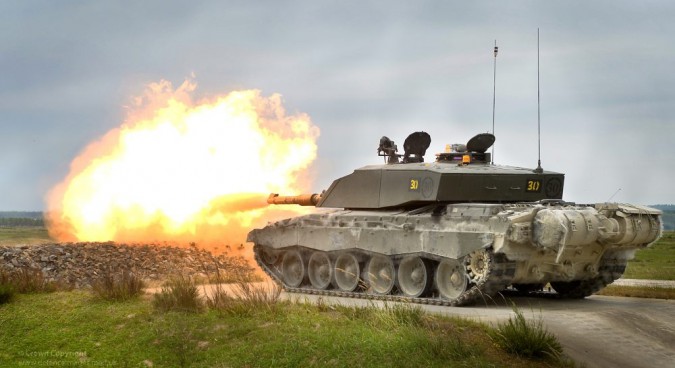
Featured Image: Challenger 2 Tank Live Firing During Exercise by Defence Images on 2013-05-16 18:58:08

Russian Embassy in N.Korea officials visits flood-struck regions

Russian Embassy in N.Korea officials visits flood-struck regions
Embassy says trip is aimed at "defining" what aid will be sent from Moscow
October 21st, 2016

Top officials from the Russian Embassy in North Korea, including the Ambassador, have visited the country’s flood-stricken regions in the north, the embassy reported on its official website.
The trip to Musan County and Hoeryong City lasted from October 18 to 21, the embassy said, and was intended to lay out the future aid that is to arrive from Moscow.
“As a result (of the flood), 15,722 households are partially or completely damaged, approximately 40,000 citizens are left homeless, and 450 people are dead or missing,” the embassy said on Friday. “We sincerely wish our Korean friends a speedy recovery from the devastating aftermath of the 2016 flooding.”
The Ambassador and Consul General of Russia were greeted by the vice-chairman of the People’s Committee in Musan, it said, adding that dozens of North Korean public buildings, including schools and kindergartens, were destroyed and some 30,000 hectares of crops had been lost.
“We overlooked intermountain areas and river valleys disfigured by water currents and covered up with stones and ooze,” it said. “We peeped into impoverished barracks and dugouts and met its dwellers. Though they have lost everything and have barely managed to stay alive, they appear optimistic.”
inside-shelter
Scenes inside the temporary flood shelters in North Korea. | Image: Russian Embassy to the DPRK
The embassy uploaded over 20 photos taken in the flood-struck regions, some showing temporary shelters made with a layer of plastic on the outside and held up by wooden pillars and frames from the inside.
Compared to the housing, most of the items inside look brand new, including giant pots to steam rice or to boil soup, plastic buckets, stainless pots and rechargeable batteries, all provided by the North Korean government, the embassy said.
“200,000 volunteers, hundreds of vehicles, a whole amount of cement and steel produced by DPRK plants, sets of clothes, utensils and food packed by each and every Korean family across the country – everything is tailored to the needs of North Hamgyong,” it said.
14707963_501801053327022_5958646898071374111_o
Construction site of new housing for the flood victims. | Image: Russian Embassy to the DPRK
The embassy briefly mentioned the foreign help being provided, too, saying it is “impossible to ignore international aid.”
“A number of UN organizations render substantial assistance. Certain countries have expressed their willingness to offer help as well.”
The embassy also forecasted the aid that will be arriving in the region from Moscow.
“Our trip was also aimed at defining the list of Russian humanitarian aid items and the ways to deliver them,” it said.
Edited by: Oliver Hotham